Wednesday, March 25, 2009

The Untimely Demise of the Home Schooled Girl


What is it about the home schooled girl that drives writers to make her a tragic heroine? Is there something about her independence added to her quirky cuteness that dooms her in young adult literature? Do male writers, ashamed of their guilty crushes on these characters, feel compelled to do away with them? Why does the male protagonist betray the home schooled girl? Why is he so terrified by her careless disregard of social teen-age norms?

I've been thinking about this after reading three (well... four) titles that on the surface have nothing in common - Shakespeare's The Tempest, M.T. Anderson's Feed*, and Jerry Spinelli's Stargirl (and Love, Stargirl too).

My English 102 students have been reading Shakespeare's play about the magical events that occur when a boat-load of Italian nobels are shipwrecked on an island inhabitted by the magician (and former Italian nobel) Prospero, his servants Ariel and Caliban, and his daughter Miranda - who has been raised and schooled on the island by no one but her father. My class keeps coming back to their discussion of Miranda who perplexes them. Why is she so docile? How can she seem so well-educated and well-spoken and still be easily directed, first by her father and then her love-interest, the recently-stranded Ferdinand? Is her marriage to Ferdinand a blessing or a type of imprisonment? All of the characters consider her to be the perfect image of a young woman, and yet she seems so unreal.

Violet, the heroine of Feed is likewise "too perfect." Anderson's setting is a futuristic and apocolyptic world where the internet is implanted in the brains of those who can afford it and consumerism runs amok destroying what is left of our fragile ecosystem, The book is masterfully constructed and the teen male narrator, Titus, wins over the readers with his honest voice. Titus falls for the homeschooled Violet, who questions the fate of her world while trying to participate in it. She, like Miranda, is the "perfect" girl - beautiful, smart, funny, in love with Titus, and ultimately killed by the faulty internet implant. Her death was terrible... mostly because Titus has broken up with her because she is too needy and "uncool" - oh, Titus, how could you?
Spinelli's Stargirl doesn't die (and thank goodness has a sequel) but like Violet, she is betrayed by her guy, Leo, who when faced with the choice of dumping Stargirl and becoming unpopular, he chooses his reputation - et tu, Leo? It is only when Stargirl has moved out of state that he realizes what he has lost.


Won't someone save these girls?
* Excuse me, have you read the Astonishing Life of Octavian Nothing? If not, you should stop reading this blog this instant and go find yourself a copy and begin reading it right away.


Friday, March 13, 2009

Unfortunate


"Let’s start by saying I have a lot of money. I’ve acquired it by writing children’s books about terrible things happening to orphans, and this seems like such a crazy and possibly monstrous way of acquiring money that I give a lot of it away." - Daniel Handler in a June 10, 2007 New York Times article.

He's right. There is something monstrous about the success of The Series of Unfortunate Events, which Handler writes under his pseudonymn of Lemony Snicket, just like there is something monstrous about The Basic Eight (Handler's first novel, the tale of a psychotic teen who goes on a killing spree with a croquette mallet - which is, not surprisingly and unmistakably, for adults, or more specifically adults with a taste for snarky, funny, and graphically violent prose).

I'll happily admit that I find that snarkiness to be delightfully entertaining, in both his adult and children's book, but I am aware that this is a guilty pleasure. One can't truely delight in these books without having a slightly queasy feeling about the nastiness of his characters' peril.

Ah... how unfortunate...

*** Another quandry... should one read the books for Brett Helquists pictures? Or listen to Tim Curry's recorded book narration?

Wednesday, March 11, 2009

Owl In Love


Kindl, Patrice. Owl in Love. Houghton, 1993.


My 13 year old daughter, Aitana, would love this book, but she won't read it. She said the cover looks creepy.


Why does it look creepy? Is it the greyed tones of the girl's face on the cover? Is it the overlay of the owl's wing across her brow? Is it the blurb that reads "School girl by day, owl by night..." Aitana won't say (which I suppose is a new standard for my now teenage daughter).


Why would she love it? Here are my top five reasons (with SPOILERS - be warned!):


  1. The main character is named Owl Tycho, which is clearly a cool name.

  2. Owl is a sulky, ostracized teenage girl, so my daughter should empathize entirely with her.

  3. Owl is magic; she is the daughter of witches and a shape changer - again, clearly cool.

  4. Owl's love interest is a dark and damaged boy, Aitana's favorite flavor!

  5. Kindl has written this beautifully. The first person narration may at first seem stilted, until one realizes that Owl is a girl with a 18th-century soul forced to negotiate her way through a 20th-century world. Owl's struggles as she is befriended by Dawn, a wonderfully complex character in her own right, are the real heart of this novel and develop questions of friendship to which any teen can relate.

Monday, March 9, 2009

A Continental Flavor


I've recently listened to two books on CD, both narrator by Patricia Conolly, that confirmed a sneaking suspicion I've had regarding the difference between Continental European writing for children and US, or even British, writing for the same audience.


Silvana De Mari's The Last Dragon and Eva Ibbotson's The Dragonfly Pool couldn't be two more different types of books. The first is a fantasy which tells the story of Yorsh, the last elf, and the humans with whom he interacts, and the last dragon. It is high fantasy, spanning the lives of two generations, with only lightly veiled commentary on human politics and quite a bit of wry humor.


The second is historical fiction, though Ibbotson is probably better known for her fantasy. It is the story of Tally, a girl who is sent from London to a "progressive school" at the start of World War II, and then travels to the fictionalized "Bergania" which seems to hearken back to Ibottson's own native Austria. The narrative then switches to focus on Karil, the prince of the soon invaded country.


What is the similarity between these two?


I think it is pacing. Like Cornelia Funke, both Di Mari and Ibbotson take their time telling this story. The pleasure in these tales is not the breathtaking action scenes, but the overlays and reflections as we move from one scene to the next, delighting in the clever foreshadowing and backtracking and subtle humor. I wonder if this is a "continental flavor?"


Tuesday, February 10, 2009

Guardian of the Spirit


I've just finished Cathy Hirano's translation of Nahoki Uehashi's Moribito: Guardian of the Spirit, which just won the 2008 Batchelder (the ALA award for a work in translation). Cathy participates in the Rutger's Children's Literature litserve and had posted about her translation and the challenges she was facing, so I was curious to see the finished product - which is gorgeous! The pages are heavy and expensive feeling; the text is printed in a lovely navy ink while elegant (though not particularly Japanese?) graphics grace the margins of each page in a slate colored ink. Each chapter opens with a quarter page graphic that looks like a stone with a stylized carving. And the three sections of the book are graced with Yuko Shimizu's compelling prints which feature the heroine, Balsa, and Chagum, the young prince she is charged to protect. The whole book is lavishly produced and an aesthetic pleasure to hold and admire.


But what about the book itself?


The story is compelling, even if one has seen the anime version or read the manga. This book is written like folklore, and the writing works! I enjoyed the imagry and the characters and was surprised at what a quick read this was.


Wednesday, February 4, 2009

The Problem with Pendragon


I've just finished Raven Rise, book nine (nine!) of the D.J. MacHale Pendragon series, and this book confirms what I realized in book one (and then again in books two through eight) - these books are dreadfully written. The stock characters seem to be lifted from popular TV series (the cocky, sporty girl side kick, the nerdy and smart boy, the aging and wise black man, a young Crocodile-Dundee, etc.), the plot is convoluted and confusing, and the dialogue - ugh - the dialogue is simply awful (the powerful call to battle by Bobby Pendragon, the teen protagonist, is "I say... we are so not done yet").


So why am I still reading them?


These books aren't really a pleasure - they are violent and confusing and just poorly written - but I can't figure out what makes the fantasy tick. I'm waiting for a revelation about how the magic works in MacHale's vision, because I can't for the life of me figure it out. Bobby, a Traveller, uses a magic ring to active "flumes" which are tunnels connecting our world (Second Earth) to nine other locations. But out of those nine locations two more are also "earth" - Earth in the 1940's and Earth in 3000-something. But only one other world has two time locations . Why is that? And sometimes the flumes work and sometimes they don't. Why? And the antagonist (who is so painfully cliched that it is hard to take him seriously) seems to be able to control the magic, but Bobby can't. Why?


One of the trademarks of effective fantasy is the consistency of the magical world, and the clear laws that the magic will follow. A fantasy that allows magic to work unchecked usually is confusing and uninteresting, where magic becomes the unconvincing solution to each of the protagonist's problems.


I've kept reading the series, because every fantasy-instinct I possess tells me that all of these confusing plot lines must iron themselves out.


And yet, I fear that I will be terribly disappointed when the final book comes out.

Thursday, January 15, 2009

Bringing the Blog Up to Date


I haven't posted in a while, but now that school is back in session, I'm ready to start sharing reviews and thoughts on Children's Literature again.


So what have I been reading? Perhaps the better question is what have I been listening to? Over my semester break I found that I wasn't reading as much as I normally do, but I did listen to several recorded books.


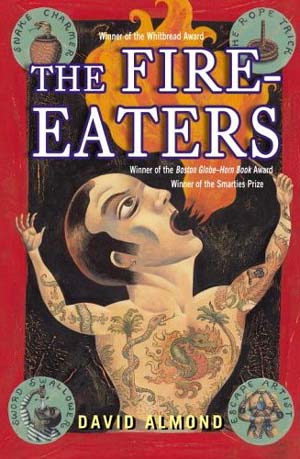
I listened to Daniel Gerroll's performance of The Fire Eaters. This is another of David Almond's lyrical and sorrowful novels. Like Skellig, Almond's best known novel about children who discover a broken angel in their back yard, this novel too exists in the realm of magical realism, but, instead of a contemporary setting, The Fire Eaters is also a work of historical fiction, taking place during the Cuban Missle Crisis. The language, for US readers may be a challenge since Almond draws on the vocabulary and dialect of his own native northern England.


I had difficulty listening to this novel. While I appreciate Almond's poetic voice and Gerroll's evocative reading, the pain, both physical and emotional, that is laced through this book was hard to stomach. The title character, McNulty the Fire Eater, is masochistic and Bobby Burns, the young narrator is drawn to that masochistic nature. He wonders if, by inflicting pain upon himself, he can take pain from others.


As I write this, I wonder if this is a children's novel - though I did not doubt the fact when listening to it. I think this would appeal to those older middle-schoolers and high schoolers as well.